

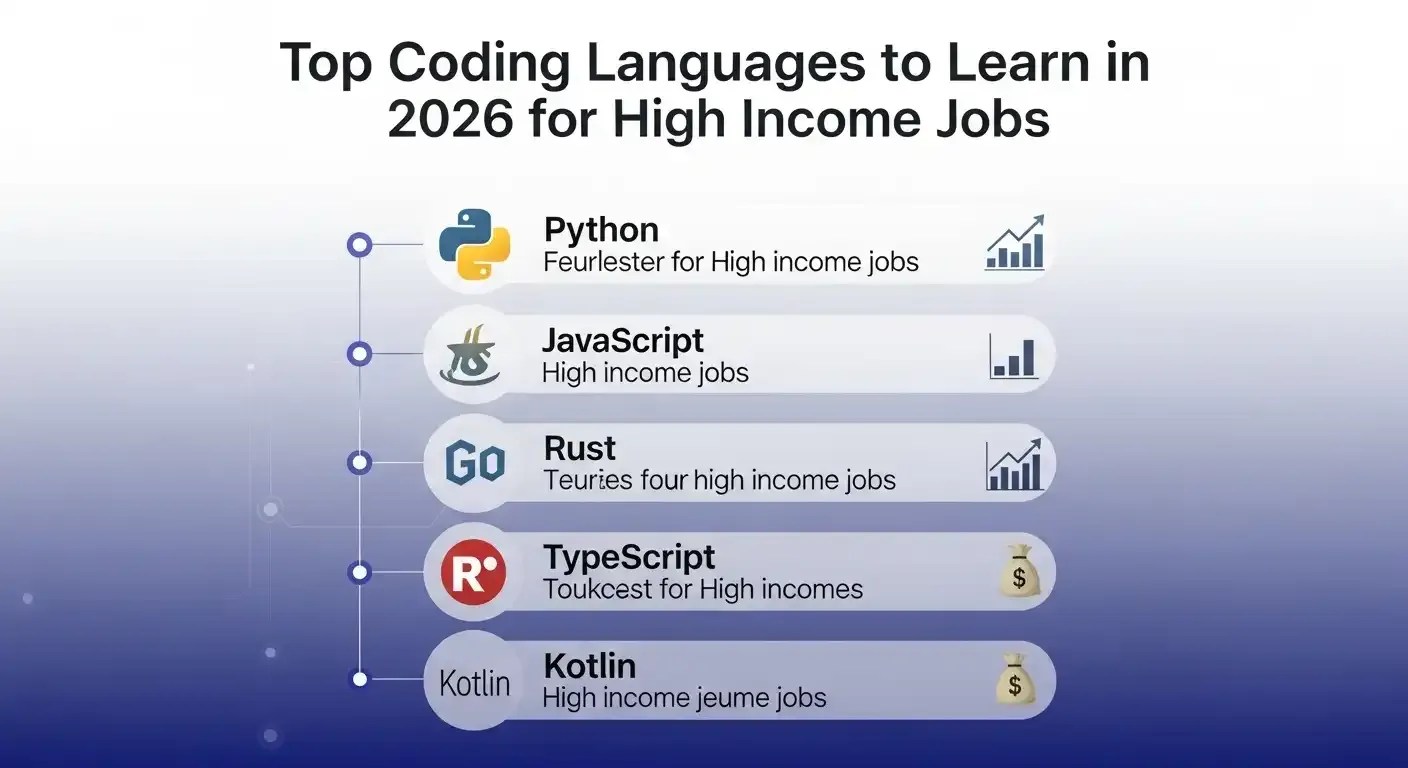
Is it too late to learn coding? As we approach 2026, the technology landscape is shifting rapidly. While you shouldn't necessarily change who you are, when the times demand adaptation, evolving your skillset is absolute crucial. Whether you are a college student wondering where to start or a working professional looking to pivot, understanding which technologies will rule the market is the key to career longevity.
At Sprite Genix, we analyze industry shifts to help you stay ahead. Today, we are diving deep into the top programming languages that will be in high demand in 2026. As experts suggest, there is no inherently "good" or "bad" language; it is all about the use case, the client’s budget, and the specific domain requirements.
Here is your roadmap to the high-income coding skills of the future.
1. JavaScript: The King That Refuses to Die
If there is one language that defines the modern web, it is JavaScript. Industry experts refer to it as "The King That Refuses to Die" because it is no longer just an optional skill—it is a survival skill.
In the past, JavaScript was primarily a client-side scripting language. However, in the lead-up to 2026, modern JavaScript has evolved into a full-stack powerhouse. It is not just about making buttons click; you can now script on the server end using modern syntax. With the ecosystem of React, Next.js, Node.js, and Express, you are not just a frontend developer; you are a JavaScript engineer capable of building APIs, dashboards, extensions, and internal company tools.
Why learn it? If you are a web enthusiast, this is non-negotiable. Whether you are working on the frontend or backend, JavaScript demand is steadily increasing. It remains the dominant force for anyone wanting to explore the web.
2. Python: The Brain of the AI Economy
If JavaScript rules the web, Python rules the data. Heading into 2026, Python is practically synonymous with power. It is widely considered the "brain of the AI economy".
The beauty of Python lies in its efficiency. Its syntax allows developers to achieve complex functionality with very few lines of code. This accessibility has made it the backbone of the current AI revolution. From ChatGPT and AI agents to automation pipelines and bots, Python is everywhere.
Why learn it? If your career goals involve Data Science, Artificial Intelligence, or Machine Learning, Python is the best option for you. While web development allows for scripting, Python allows you to build a career in the high-growth sectors of data and AI.
3. Java: The Money Engine
For years, skeptics have predicted the decline of Java, yet it remains the "money engine" of the software world. If you look at the systems that run the world’s finances—banking, fintech, payment gateways, and insurance platforms—you will find Java on the backend.
Java acts as the backbone for enterprise architecture. Its strong typing and reliability make it the go-to for product companies and the government sector alike. While newer languages are emerging, the demand for Java is "evergreen".
Why learn it? High-paying jobs plus evergreen demand equals career security. As long as versions continue to be upgraded and companies rely on it for massive transactional systems, Java developers will be needed.
4. Go (Golang): The Cloud Killer
A significant shift is happening in backend infrastructure. While Java is still dominant, many companies are migrating their systems to the Go language, often referred to as the "cloud killer".
Go is increasingly used in backend infrastructure, cloud development, and high-scale systems. We are seeing a trend where engineers who previously worked in Java are shifting to Go for building AWS internal tools, scalable APIs, and microservices.
Why learn it? If you have experience in Java or Spring Boot, Go is an excellent language to add to your arsenal. It offers high performance and is seeing rapid growth in demand, making it a smart switch for experienced developers looking for a salary bump in cloud engineering.
5. Rust: Security and Long-Term Performance
Looking further into the future, Rust is positioning itself as a critical language for security and system-level programming. It is becoming the standard for WebAssembly and high-performance tools in the Web3 infrastructure.
Many cybersecurity startups are building their internal tools on Rust because of its memory safety features.
Why learn it? For a long-term career strategy, Rust is going to be in high demand. If you want to delve into hard-core security or high-performance systems, Rust is the superior choice.
6. TypeScript: The Enterprise Upgrade
While we discussed JavaScript earlier, TypeScript deserves its own spotlight. You can think of it as an upgraded version of JavaScript that provides security and type safety.
JavaScript does not provide direct security, which can lead to production errors. TypeScript solves this, making code more scalable and enterprise-ready.
Why learn it? If you are serious about web development, you should definitely learn TypeScript. It is crucial for writing better, cleaner code and is highly requested in job descriptions for modern frontend roles.
Conclusion: How to Decide?
With so many options, how do you choose? It comes down to your career focus.
• Frontend & Web: Go with JavaScript and TypeScript.
• Data & AI: Go with Python.
• Backend & Cloud: Go with Java or Go (Golang).
• Security: Go with Rust.
Remember, languages like PHP and .NET are not dead; they serve specific budget-oriented or enterprise service needs. However, for high-income potential in product-based companies, the languages listed above are your best bets for 2026. These top languages are evergreen, and mastering them ensures you stay relevant in a changing market.
Frequently Asked Questions (FAQ)
1. Is it too late to start learning to code for 2026?
No, it is not too late. While you shouldn't change yourself unnecessarily, if the times demand it, examining yourself and progressing with new skills is crucial for your career.
2. Which programming language is best for AI jobs?
Python is the best option for AI. It is considered the "brain of the AI economy," powering everything from ChatGPT to data pipelines and automation tools.
3. Is Java still a good language to learn for high salaries?
Yes. Java is described as the "money engine" and is the backbone of banking, fintech, and insurance sectors. It offers high-paying jobs and career security due to its evergreen demand.
4. What is the difference between JavaScript and TypeScript?
TypeScript is essentially an upgraded version of JavaScript that adds security and type safety. While JavaScript is a survival skill for the web, TypeScript makes code enterprise-ready and reduces errors.
5. Why are companies switching from Java to Go (Golang)?
Companies are migrating to Go for cloud infrastructure and high-scale systems due to its performance. It is becoming a "cloud killer" for microservices and scalable APIs.
Category: Tech Industry Trends