

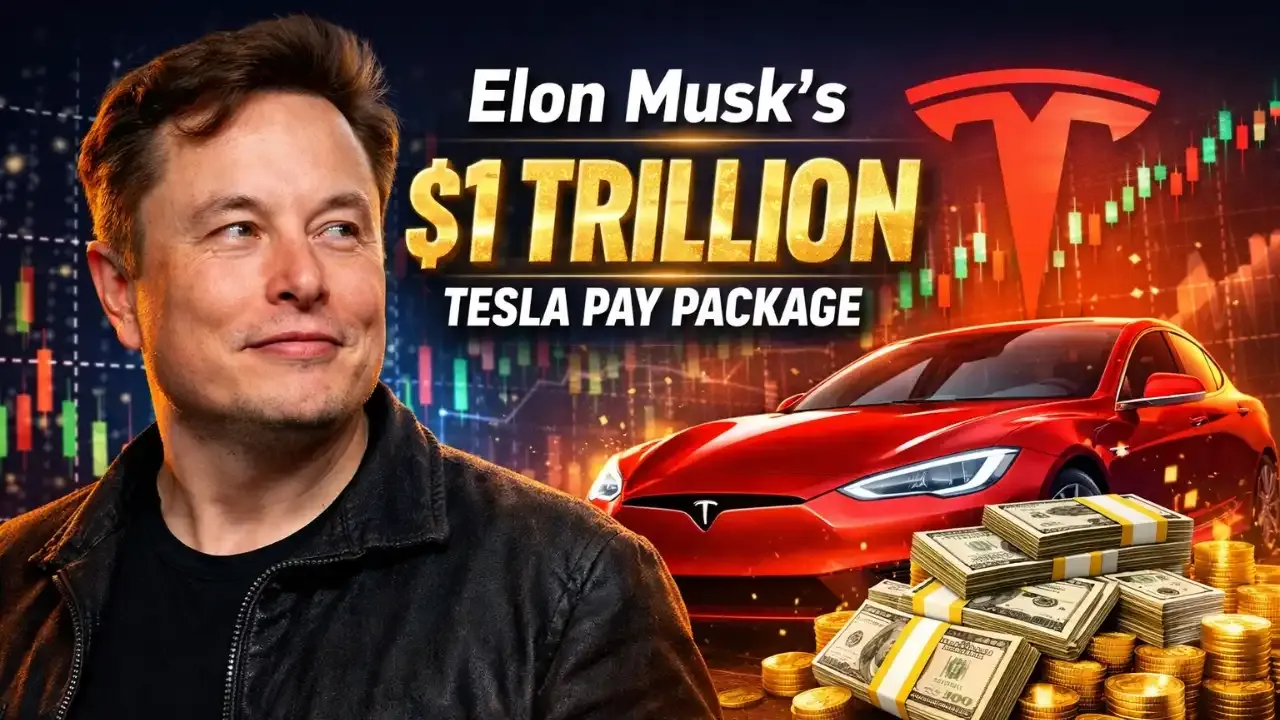
On November 6, 2025, corporate history witnessed an unprecedented event: Tesla shareholders approved a monumental $1 trillion compensation plan for CEO Elon Musk. Spanning over the next ten years, this massive compensation dwarfs anything seen before.
To put this in perspective, other top CEOs earn mere fractions of this amount; Tim Cook earns roughly $74 million yearly, Satya Nadella around $79 million, Mark Zuckerberg $27 million, and Sundar Pichai $10 million. By contrast, the Elon Musk trillion dollar package averages a staggering $100 billion per year.
However, this Tesla compensation plan comes with a massive catch: it is a 100% performance-based structure. If Musk fails to hit 12 nearly impossible targets, his payout is absolutely zero. Here at Sprite Genix, we analyze industry shifts to help businesses understand how top-tier leadership strategies shape the global market. In this article, we will perform a deep dive into the most ambitious corporate payout in human history, the driving factors behind it, and whether these targets can actually be achieved.
The Precedent: Why Tesla Used This Strategy Before
To understand the 2025 Elon Musk trillion dollar package, we must look back at a similar corporate drama from 2018. In March 2018, Tesla was in critical condition and merely weeks away from potential bankruptcy. The company was trapped in what the industry called "production hell," manufacturing only 1,000 Model 3 cars per week instead of the targeted 5,000.
Tesla desperately needed the Model 3 to survive. Before this, the company relied on the Roadster, Model S, and Model X, selling only about 50,000 luxury cars per year. To offset massive fixed costs like factories and salaries, Tesla needed high-volume production. Compounding the pressure, Tesla held 500,000 pre-orders for the Model 3 with $1,000 deposits each. If they failed to deliver, they would have to refund $500 million in cash they didn't have, leading to instant bankruptcy.
Faced with this existential threat, the Tesla board decided to bet everything on Elon Musk. They created a 12-tranche, performance-based compensation package offering zero guaranteed salary. The ultimate goal was to grow Tesla's market cap to an astronomical $650 billion.
Against all odds, Musk over-delivered. By late 2021, Tesla's market cap skyrocketed to $1.2 trillion, making it the world’s most valuable car company. Despite hitting all his targets to unlock $56 billion, a single Tesla shareholder filed a lawsuit claiming the compensation was excessive. Agreeing with the shareholder, a Delaware court judge voided the $56 billion package, setting the stage for ongoing legal battles.
The 2025 Crisis: The Need for the Elon Musk Trillion Dollar Package
Fast forward to 2025, and Tesla faces a familiar sense of urgency. For the first time, Tesla's annual sales are experiencing a sharp decline, with an estimated 1.6 million fewer cars delivered in 2025. In Europe alone, Tesla's market share plummeted from 17% in 2024 to just 8%.
Simultaneously, competitors are rapidly taking over. China's BYD has claimed the global EV crown with a 20% market share, leaving Tesla behind at 7.7%. Other Chinese rivals like Xiaomi and Nio are aggressively capturing the market by offering similar features at lower price points, while Tesla's flagship Model 3 and Model Y still look largely the same as they did six years ago.
Musk believes Tesla can only reclaim its dominance by pivoting from a traditional EV company to an AI and humanoid robot powerhouse. However, after selling significant Tesla stock to purchase Twitter in 2022, Musk lacks the voting rights needed to safely control this new vision. He publicly stated that without a fair deal specifically enough control to ensure his AI ambitions aren't halted by the board—he might develop these technologies at his other companies like xAI and Neuralink instead.
To lock in his focus and prevent him from leaving, the board approved the new Tesla compensation plan.
Decoding the 12 "Impossible" Targets
To become the world's first trillionaire through this package, Musk must successfully navigate 12 distinct tranches, each requiring him to hit both market cap and operational milestones.
The Market Cap Goals
- Base Milestone: Reach a $1 trillion market cap.
- Incremental Growth: Add $500 billion in market value across the next nine tranches, pushing the valuation to $6.5 trillion.
- Final Stretch: Add $1 trillion for each of the final two tranches, achieving a staggering ultimate target of an $8.5 trillion market cap.
The Operational Goals
To unlock his shares, Musk must also ensure the company hits historical operational milestones:
- Sell a lifetime total of 20 million Tesla vehicles.
- Deploy 1 million autonomous Robotaxis into commercial operation.
- Sell 1 million Optimus robots.
- Reach 10 million paid Full Self-Driving (FSD) subscribers.
If Musk hits these rigorous targets, he unlocks a 1% stake in Tesla per tranche. Completing all 12 tranches awards him a 12% stake valued at $1 trillion, though he is contractually forbidden from selling these shares for 7.5 years.
Is the Tesla Market Cap Goal Feasible?
Reaching an $8.5 trillion market cap is an incredibly steep climb. This figure is more than double Apple's current valuation, and even Nvidia's massive AI-driven boom only pushed its peak market cap to $5 trillion. For Tesla to hit $8.5 trillion from its current $1.4 trillion valuation, it requires exponential, unprecedented growth supported entirely by the success of Robotaxis and humanoid robots.
On the operational side, selling 20 million cars lifetime means Tesla must average 1.2 million car sales annually over the next decade. While they currently sell about 1.8 million annually, defending this market share against fierce Chinese competition remains a critical challenge.
Furthermore, deploying 1 million Robotaxis and Optimus robots involves heavy regulatory and technical hurdles. A Robotaxi is effectively a fully autonomous Uber without a driver, requiring Tesla to convince global governments to allow them on public streets—a massive liability challenge. Meanwhile, the humanoid robot space is becoming heavily saturated; China alone has over 150 companies entering this emerging domain, prompting the Chinese government to warn of a potential market bubble.
Driving Unprecedented Growth with Sprite Genix
The Elon Musk trillion dollar package proves that visionary leadership requires aggressive, data-driven goals and flawless execution. If a business wants to dominate its sector, it cannot rely on outdated strategies. At Sprite Genix, we help modern brands adopt scalable, high-ranking content and digital marketing strategies that keep you ahead of the competition.
FAQs
1. What is the total value of Elon Musk's 2025 pay package?
The 2025 compensation plan is valued at an unprecedented $1 trillion over the next 10 years.
2. Is Elon Musk guaranteed to receive this $1 trillion?
No, the package is 100% performance-based. If he fails to hit the 12 specific targets, he receives zero compensation.
3. Why did a judge void Musk's 2018 pay package?
A Delaware court judge voided the 2018 $56 billion package after a shareholder lawsuit claimed the compensation was unfairly high and poorly negotiated by the board.
4. What is the ultimate market cap goal for Tesla in this new package? To fulfill the final tranche of the package, Tesla must achieve an astronomical market cap of $8.5 trillion.
5. What operational goals must Musk achieve to get paid?
Musk must oversee the lifetime sale of 20 million vehicles, deploy 1 million Robotaxis, sell 1 million Optimus robots, and secure 10 million paid FSD subscribers.
Ready to Scale Your Business?
At Sprite Genix, we craft SEO-optimized, data-driven content that builds authority, drives organic traffic, and turns ambitious goals into measurable realities. Contact Sprite Genix today to elevate your digital marketing strategy and secure your spot at the top of your industry!
Category: Business and Entrepreneurship