

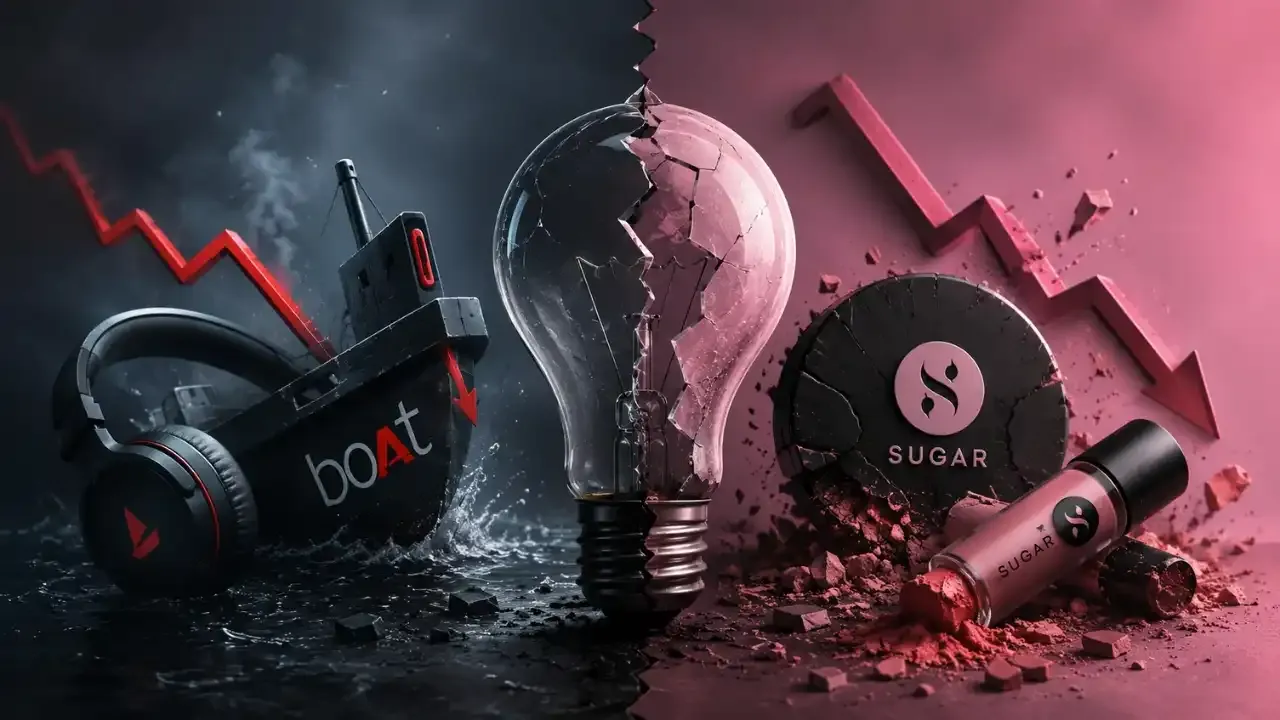
The modern startup ecosystem is filled with glamorous valuations, aggressive marketing campaigns, and charismatic founders who dominate reality television screens. But what happens when you peek behind the curtain of these supposed unicorns? At Sprite Genix, a leading digital marketing agency in Delhi, we believe in generating leads and profitable revenue through transparent, data-driven strategies. We analyze market trends deeply because we know that superficial metrics often mask a turbulent reality.
Today, we are unpacking the unfiltered, dark reality of two celebrated Indian brands: BoAt and Sugar Cosmetics. Let us look past the PR stunts to uncover the foundational flaws, aggressive capital burning, and critical business lessons every entrepreneur must learn.
BoAt’s Dark Reality: A Marketing Gimmick in Disguise?
At first glance, Aman Gupta’s BoAt appears to be a monumental success, boasting revenues around ₹3,000 crore. However, a closer inspection reveals that the brand is struggling beneath the weight of its own rapid expansion and lack of true innovation.
Over-Diversification and White-Labeling Flaws
BoAt’s parent company, Imagine Marketing Limited, is fundamentally not a product innovation company; rather, its business model heavily relies on white-labeling goods imported from China and slapping a brand logo on them. Realizing that they held a 33% market share in audio wearables but lacked room for upward growth, the founders embarked on an aggressive, poorly executed diversification spree.
Instead of strengthening a single brand, they acquired and launched multiple sub-brands that ended up cannibalizing their focus:
Redgear: Acquired in 2020 to target gamers, but failed to remain relevant post-pandemic.
Tag: Launched to compete in the premium segment against giants like JBL and Sony, yet its financial numbers remain mysteriously undisclosed.
Defy & Misfit: Defy was launched as another budget gaming audio brand (promoted by Guru Randhawa), while Misfit bizarrely ventured into men’s grooming and trimmers.
Despite this chaotic expansion, BoAt's core audio wearables still account for 84% of their ₹3,370 crore revenue, while these four sub-brands combined contribute a measly 5%. This is a classic cautionary tale of how spreading resources too thin damages overall brand equity.
The R&D Deficit vs. Skyrocketing Marketing Spends
The most glaring issue with BoAt is its financial allocation. Truly successful tech hardware brands like Apple or Samsung invest roughly 6% to 9% of their revenue into Research & Development (R&D). BoAt, however, spends a mere 1% on R&D.
Instead of innovating, the company attempts to buy customer attention. In 2022, BoAt spent just 3.6% of its revenue on marketing, but as organic growth stalled, this figure violently surged to nearly 30%. When a brand must spend ₹30 on ads just to sell a ₹100 product, it is no longer a sustainable product company—it is merely a marketing agency selling imported hardware.
The IPO Red Flags and Crashing Categories
BoAt's attempt to go public was delayed due to severe internal discrepancies. Their balance sheets did not match, and audits revealed a staggering nine red flags. Furthermore, their highly touted smartwatch segment faced a catastrophic decline, dropping 63% in just two years—plummeting from ₹901 crore in 2023 to a dismal ₹30 crore by 2025. Add to this the fact that their Singapore-based subsidiary (Kaaha) was exposed for failing to pay vendors and employee salaries, potentially accumulating massive debt liabilities.
Sugar Cosmetics: 12 Years of Bleeding Capital
While BoAt wrestles with hardware limitations, Vineeta Singh’s Sugar Cosmetics faces a different, equally damaging dark reality. Operating for over 12 years, Sugar has notoriously failed to achieve profitability.
Staggering Financial Losses
Sugar Cosmetics saw promising initial growth by targeting Tier-2 and Tier-3 cities with products tailored for Indian skin tones. Their revenue climbed to ₹515 crore by 2024, keeping the illusion of stability alive.
However, the bubble burst in 2025. Revenue dropped by 20% to ₹412 crore, while their financial losses violently ballooned from ₹68 crore to an astonishing ₹135 crore. For a company operating for more than a decade, burning cash at this accelerating rate indicates deep-rooted systemic flaws.
Brand Dilution Through Unnecessary Sub-Brands
Much like BoAt, Sugar attempted to solve its revenue problems by launching an array of disconnected sub-brands:
Sugar Pop: Created to offer cheaper products, this move severely diluted the premium trust built around the original Sugar brand.
Quench Botanics: A pivot into the Korean skincare trend that failed to fend off dominant Chinese competitors.
EW N Beauty & Molten Beauty: Ventures into Ayurvedic health and further cost-efficient makeup that only added to operational chaos without delivering transparent standalone revenues.
Instead of fixing the unit economics of their primary brand, Sugar kept creating new ones, resulting in a fractured identity and alienated consumer base. Furthermore, as sales plummeted, the founder pivoted to launching the "Sugar Coated" podcast to build personal face value, prioritizing PR over fixing a bleeding balance sheet.
Key Takeaways: How Sprite Genix Can Protect Your Brand
The dark reality of BoAt and Sugar Cosmetics proves that relying entirely on marketing gimmicks, aggressive discounting, and uncalculated diversification will eventually lead to financial ruin.
At Sprite Genix, we don't just run ads; we build sustainable Digital Marketing Strategies tailored for long-term value. With over 100+ trusted clients and 49 successfully completed projects, our Business Solutions ensure that your brand scales profitably without burning unnecessary capital. We focus on customer insights and execution to generate leads that convert into actual profitable revenue, keeping our clients far away from the pitfalls of blind expansion.
Whether you need elite Search Engine Optimization (SEO) to drive organic traffic, robust Web Development, or comprehensive brand management, our expert team in Delhi NCR is ready to elevate your business. Let us help you build a brand that relies on solid fundamentals, not just fleeting hype.
FAQs
1. Why did BoAt's IPO get delayed?
BoAt's IPO was delayed after auditors found nine red flags, including mismatched balance sheets, undisclosed losses in their Singapore subsidiary, and massive drops in their smartwatch sales.
2. Is Sugar Cosmetics a profitable company?
No, despite operating for 12 years, Sugar Cosmetics remains unprofitable. In 2025, their losses nearly doubled to ₹135 crore while their revenue dropped to ₹412 crore.
3. Why do BoAt and Sugar launch so many sub-brands?
Both brands launched multiple sub-brands (like Redgear, Defy, Sugar Pop, and Quench Botanics) in an attempt to capture different market segments and artificially boost valuation, which ultimately diluted their core focus.
4. How much does BoAt spend on R&D versus marketing?
BoAt operates more like a marketing agency than a tech company, spending nearly 30% of its revenue on marketing and advertisements, while allocating only a meager 1% to R&D.
5. How can Sprite Genix help my startup avoid these failures?
Sprite Genix offers transparent, cost-effective digital marketing and business solutions. We optimize your marketing strategy to increase long-term sales and leads without burning your budget on ineffective campaigns.
Ready to build a profitable, data-driven brand that outlasts the hype? Don't let poor strategy drain your capital. Partner with Sprite Genix, Delhi's premier digital marketing agency, for sustainable growth, elite SEO, and tailored business solutions.
📞 Call us today: +91 8957865554
✉️ Email: hello@spritegenix.com
🌐 Let's get your project started and amplify your business today!
Category: Business and Entrepreneurship