

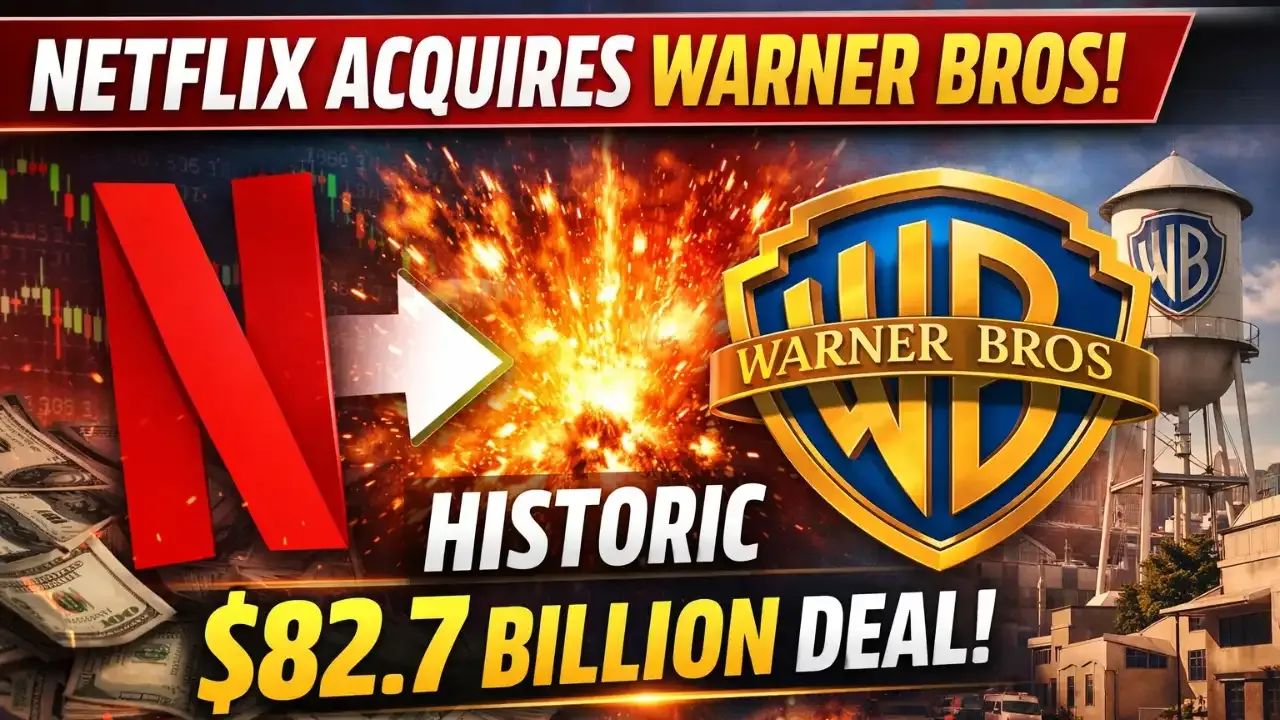
On December 5, 2025, the digital landscape witnessed an earth-shattering event that officially became Hollywood’s worst nightmare. Streaming giant Netflix released a joint press statement announcing a definitive agreement to purchase the 100-year-old Warner Bros studio for a massive $82.7 billion.
As a leading digital marketing agency, we at Sprite Genix understand that when a tech-first platform buys a legacy media powerhouse, the ripple effects redefine business strategies globally. This is not just a corporate buyout; it represents monumental media industry changes that effectively signal the end of the traditional entertainment era and the definitive climax of the streaming war.
In this comprehensive, data-driven analysis, we will break down the timeline of the Netflix Warner Bros acquisition, explore the catastrophic failures of legacy media, and detail what businesses and digital marketers can learn from Netflix’s ultimate power move.
The Timeline of the Netflix Warner Bros Acquisition
The Netflix buyout Warner Bros drama unfolded at lightning speed, showcasing cutthroat corporate competition:
- December 5, 2025: Netflix and Warner Bros announce the $82.7 billion acquisition. Immediate panic strikes Hollywood, with the Writers Guild of America demanding the deal be blocked.
- December 6, 2025: Bank of America analysts officially declare that the global streaming war is over.
- December 7, 2025: U.S. President Donald Trump publicly intervenes, raising concerns about the immense market monopoly this creates.
- December 8, 2025: Paramount attempts a hostile takeover of Warner Bros Discovery (WBD) with a massive $118.4 billion all-cash offer, sending Netflix stock dropping by 3% while Paramount’s surged by 9%.
- December 17, 2025: Ahead of a crucial legal deadline, Warner Bros Discovery officially rejects Paramount's bid, stating that the Netflix deal is fundamentally better for consumers.
Why Did Warner Bros Sell? The Collapse of Legacy Media
To understand why a historic studio like Warner Bros surrendered to a tech platform, we must look at shifting content monetization models. In 2010, former Warner Bros CEO Jeff Bewkes audaciously mocked Netflix, comparing them to the "Albanian Army" and suggesting they were too small to conquer global media. Today, Netflix is valued at $400 billion, proving that underestimating digital innovation is a fatal business error.
Historically, traditional production houses relied on a robust five-window revenue stream: theatrical releases, DVD/Blu-ray sales, video-on-demand (VOD), premium cable, and regular TV syndication. A single movie generated profits across multiple channels for years. However, the rise of the streaming industry obliterated this model.
When legacy studios like Disney, NBCUniversal, and Warner Bros tried to launch their own streaming platforms, they bled money. Between 2020 and 2024, competing platforms like Disney+, Peacock, Paramount+, and HBO Max accumulated a combined loss of $18 billion.
Warner Bros was particularly devastated. The studio launched HBO Max, rebranded it multiple times, and even created CNN+, which shut down a mere 32 days after its launch. Saddled with $43 billion in debt following its merger with Discovery, collapsing cable revenues, and $10 billion in quarterly losses by Q4 2024, the studio had two choices: go bankrupt or sell to Netflix.
What Netflix Gains from This $82.7 Billion Monopoly
The Netflix Warner Bros acquisition isn't just about eliminating a rival; it provides Netflix with four unparalleled "superpowers":
1. The 100-Year Content Vault
Netflix historically spent heavily on original content, investing roughly $17 billion between 2022 and 2024, yet only 10% to 20% of those shows became enduring hits. By acquiring Warner Bros, Netflix instantly secures a 100-year vault of guaranteed, iconic intellectual property, including Harry Potter, Game of Thrones, Friends, and the entire DC Universe.
2. Ultimate Supply Control
Warner Bros historically produced content for competing platforms, such as the hit show Ted Lasso for Apple TV. With this acquisition, Netflix becomes the ultimate supply controller. When Apple TV's streaming rights expire in 2027, Netflix can either demand exorbitant licensing fees or simply move the hit show exclusively to its own platform.
3. Legacy Production Expertise
While Netflix is a tech company with around 15 years of content creation experience, Warner Bros brings a century of world-class production infrastructure, studio facilities, and deep-rooted relationships with elite Hollywood directors and writers.
4. The Global Narrative Monopoly
With over 300 million subscribers spread across 190 countries, Netflix already had massive distribution. Combining that tech distribution with Warner Bros' legendary storytelling power gives Netflix an unprecedented narrative monopoly, allowing them to shape global perspectives on an unparalleled scale.
Roadblocks Ahead: Can the Deal Survive Antitrust Laws?
While the Netflix buyout Warner Bros is agreed upon, it faces fierce legal battles. The U.S. Department of Justice (DOJ) argues the deal violates anti-monopoly laws.
Current 2023 DOJ guidelines state that any merger capturing over 30% of the market share is illegal. Combining Netflix (the #1 streamer) with HBO Max (the #3 streamer) easily breaches this threshold. Furthermore, the deal creates dangerous horizontal integration (eliminating direct competition) and vertical integration (owning both the distribution pipeline and the content supply), which could lead to higher prices for consumers. If approved, the complex acquisition will likely finalize in late 2026.
Lessons for Digital Marketers and Businesses
At Sprite Genix, we believe the greatest takeaway from the Netflix Warner Bros acquisition is the triumph of data over guesswork. Netflix didn't win the streaming war because it had better cameras; it won because it possessed a decade of precise user behavior data, allowing them to engineer guaranteed hits like House of Cards.
Warner Bros failed because they tried to transition into a tech company overnight without the fundamental infrastructure to support it. For your business to thrive, you must adapt to digital shifts swiftly, leverage customer data appropriately, and invest heavily in sustainable SEO and digital strategies.
FAQs
1. How much did Netflix pay for Warner Bros?
Netflix announced a definitive agreement to acquire Warner Bros for $82.7 billion on December 5, 2025. The deal includes legendary franchises like Harry Potter and Game of Thrones.
2. Why did Warner Bros decide to sell to Netflix?
Warner Bros was drowning in $43 billion of debt, suffering immense streaming losses, and facing the total collapse of their traditional cable TV and theatrical revenue streams.
3. Did anyone else try to buy Warner Bros?
Yes. Paramount attempted a hostile takeover with a $118.4 billion all-cash offer on December 8, 2025, but Warner Bros officially rejected it on December 17.
4. When will the Netflix Warner Bros acquisition be finalized?
Due to the massive complexity of the corporate merger and heavy scrutiny from the Department of Justice, the deal is expected to finalize in late 2026.
5. How does this impact other streaming platforms like Apple TV?
Netflix now controls Warner Bros' IP. For example, Netflix can drastically increase licensing fees for Warner-produced shows like Ted Lasso on Apple TV, or pull them entirely.
Ready to Dominate Your Industry?
The Netflix and Warner Bros deal proves that failing to adapt to digital transformation can destroy even a 100-year-old empire. Don't let your business fall behind. At Sprite Genix, our expert team specializes in data-driven SEO, cutting-edge content marketing, and high-converting digital strategies to ensure your brand stays ahead of the competition. Contact Sprite Genix today and let's build your digital monopoly!
Category: Industry News and Updates