

We constantly monitor the tech industry trends that disrupt the digital landscape. We are a group of creative geeks who look forward to getting up every day and doing something we enjoy, which is why we want to bring you the latest, most cutting-edge insights.
On February 10, 2026, Google and Microsoft officially proposed a revolutionary new framework: the WebMCP protocol. Designed to make websites universally compatible with AI agents, this protocol is currently in its early tester preview, with a public launch targeted for the end of 2026.
If you want your business to remain competitive, understanding the WebMCP protocol is no longer optional. Let’s dive into how this technology will permanently change web development, AI agent interactions, and modern SEO strategies.
The Problem With Current AI Agent Interactions
To understand the value of the WebMCP protocol, we first need to look at how AI agents currently browse the web. When an AI system like ChatGPT, Claude, or Google’s Gemini tries to interact with a website (for example, to research a topic or shop on your behalf), it has to emulate human behavior.
Currently, the AI agent visits a page, waits for it to load, takes a visual screenshot, and sends that image back to a Large Language Model (LLM) for processing. The LLM analyzes the screenshot, figures out the next logical step, and sends instructions back to the system to click a button or fill a form. This back-and-forth screenshot methodology is incredibly slow, resource-heavy, and puts an unnecessary load on hosting servers.
What is the WebMCP Protocol?
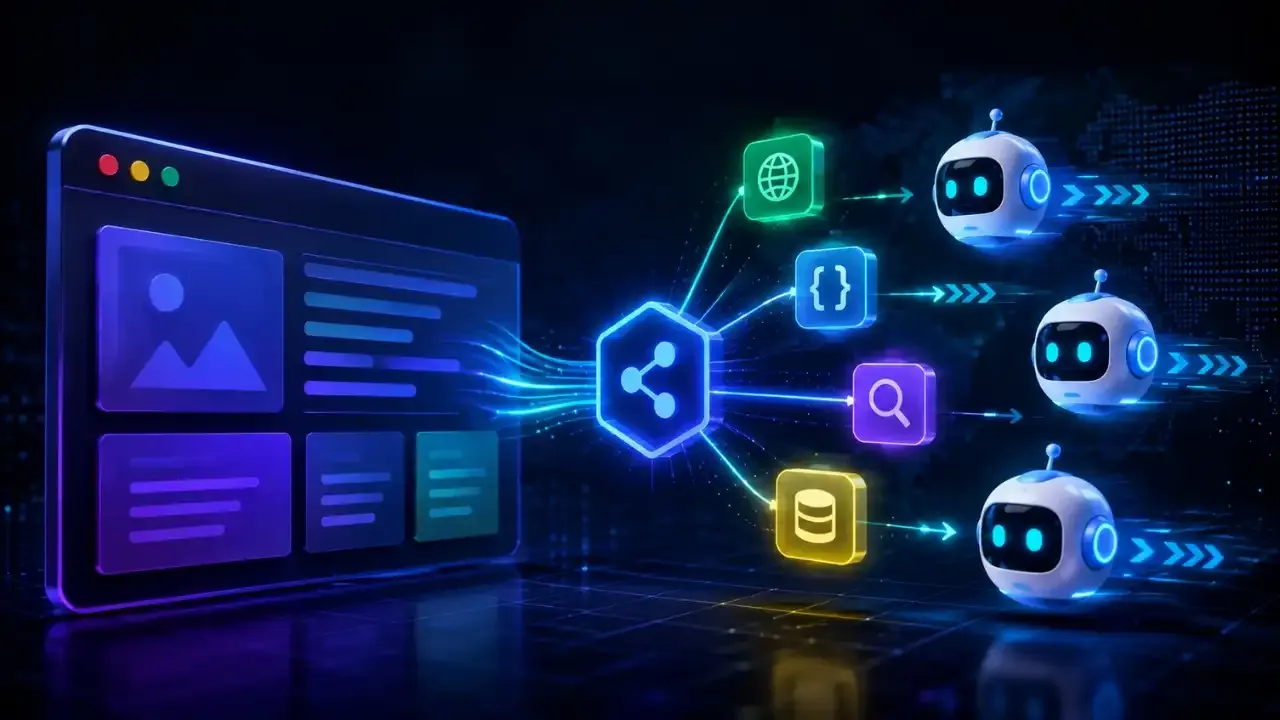
The WebMCP protocol eliminates this clunky process entirely. Instead of relying on visual screenshots, a WebMCP-enabled website proactively provides a structured list of available tools, options, and functions directly to visiting AI agents.
How WebMCP Differs from Standard MCP Servers
Many web developers ask: Why do we need WebMCP if standard MCP servers already exist?
Standard MCP servers require the website owner to build and host server-side functionalities. Whenever an AI agent takes an action, it engages the host server, driving up operational and development costs.
The WebMCP protocol offloads this responsibility. Instead of acting as a headless system, it forces AI agents to use standard browser tabs (like Google Chrome, Safari, Firefox, or Opera). The computing load is placed entirely on the user’s or AI agent’s browser rather than your website’s server, protecting your hosting resources while speeding up execution.
How WebMCP Empowers AI Agents
When the WebMCP protocol is integrated into a webpage, it provides three critical pillars of information to AI agents:
1. Discovery
Discovery is the automated process where your webpage tells AI agents exactly what tools are available. If an AI agent lands on an e-commerce page, the protocol will instantly declare that a "Product Search" function is available. If it lands on a travel site, it will announce ticket booking and cancellation capabilities.
2. JSON Schemas
Discovery tells the AI what is there, but JSON Schemas tell the AI how to use it. JSON schemas define the required inputs, tool descriptions, and expected outputs. Because of this, AI agents no longer have to guess what type of data belongs in a specific text box or dropdown menu.
3. State Awareness
Websites are dynamic, and the WebMCP protocol keeps AI agents continuously updated on page state changes. For instance, if an AI agent uses the search tool to find a product and proceeds to the cart page, WebMCP will instantly inform the agent that the "Search" tool is no longer relevant, but the "Checkout" tool is now active.
Implementing the WebMCP Protocol
Web developers can integrate the WebMCP protocol into their sites using two distinct methods:
Declarative API (HTML-Based)
The Declarative API is the easier, faster implementation method. It is HTML-based and perfect for quick integration via standard Content Management Systems (CMS). Developers simply add two new HTML attributes to existing forms: tool-name and tool-description.
Once these attributes are added, the user's browser automatically generates the necessary input schemas. When AI agents provide the required information, a built-in tool-auto-submit function automatically triggers the form submission without requiring a physical button click. Furthermore, a feature called e.agentInvoked helps developers differentiate whether a human or an AI agent triggered the submission, allowing for customized success messages.
Imperative API (JavaScript-Based)
For a cleaner, native solution with deeper functionality, developers can use the JavaScript-based Imperative API. This method uses functions like registerTool to instantly declare a tool's name, description, and required input schema to the AI agent. It also features the unregisterTool function, which is critical for state changes—allowing developers to revoke an AI’s access to a tool once the user moves to a different stage of the funnel (like moving from product search to checkout).
SEO Strategies and Future Challenges
The WebMCP protocol represents a massive shift in SEO strategies. However, because it is still in its infancy, it faces some technical hurdles. Currently, AI agents struggle with complex UI elements like e-commerce product filters, travel site seat selection interfaces, and "add to cart" events.
To succeed, SEOs must provide AI agents with absolute data certainty. For example, a restaurant booking site cannot simply offer an open timeframe of 6:00 PM to 10:00 PM and expect the AI to figure it out. Developers must hardcode strict booking slots (e.g., 6:00 to 6:30, 6:30 to 7:00) directly into the schema. If the data is vague, the AI agent will fail.
Additionally, WebMCP introduces a unique branding opportunity: custom AI interaction animations. When an AI agent is actively navigating your site, you can display custom animations featuring your brand’s exact colors and design language.
Conclusion
The WebMCP protocol will permanently change how users, search engines, and AI agents interact with the web. Websites optimized for WebMCP will secure higher visibility, improved user experiences, and faster AI task execution.
Is your website ready for the AI revolution? At Sprite Genix, we specialize in future-proofing businesses. Let’s get your digital presence WebMCP-ready today!
FAQs
1. What is the WebMCP protocol?
The WebMCP protocol is a proposed framework by Google and Microsoft that allows websites to seamlessly communicate their available tools and functions directly to AI agents without relying on visual screenshots.
2. How does WebMCP impact my website's server load?
Unlike standard MCP servers that drain host resources, WebMCP forces the AI agent to operate within the user’s browser tab, completely offloading the computing strain from your hosting servers.
3. Will WebMCP only work on Google Chrome?
No, if the protocol is widely accepted, it will become a universal web standard, meaning it will function flawlessly on Safari, Firefox, Opera, and other independent browsers.
4. What is the difference between the Declarative and Imperative APIs?
The Declarative API is a fast, HTML-based method that relies on simple attribute tags, while the Imperative API is a more robust, JavaScript-based method that allows for complex state management.
5. Why is exact data important for WebMCP SEO?
AI agents cannot make logical assumptions. SEO strategies must provide rigid, certain data (like exact booking times) in the JSON schema; otherwise, the AI will fail to complete the required action.
Ready to Optimize Your Website for the AI Era?
The future of web development is here, and early adopters will dominate the search rankings. Don't wait for your competitors to outpace you. At Sprite Genix, our creative geeks are ready to optimize your website for AI agents and supercharge your digital growth!
Call us anytime at +91 8957865554 or email us at hello@spritegenix.com. Let's build something extraordinary together! (Mon - Sat | 9am - 7pm).
Follow us on Instagram, Facebook, and LinkedIn for more updates!
Category: Web Development Insights