

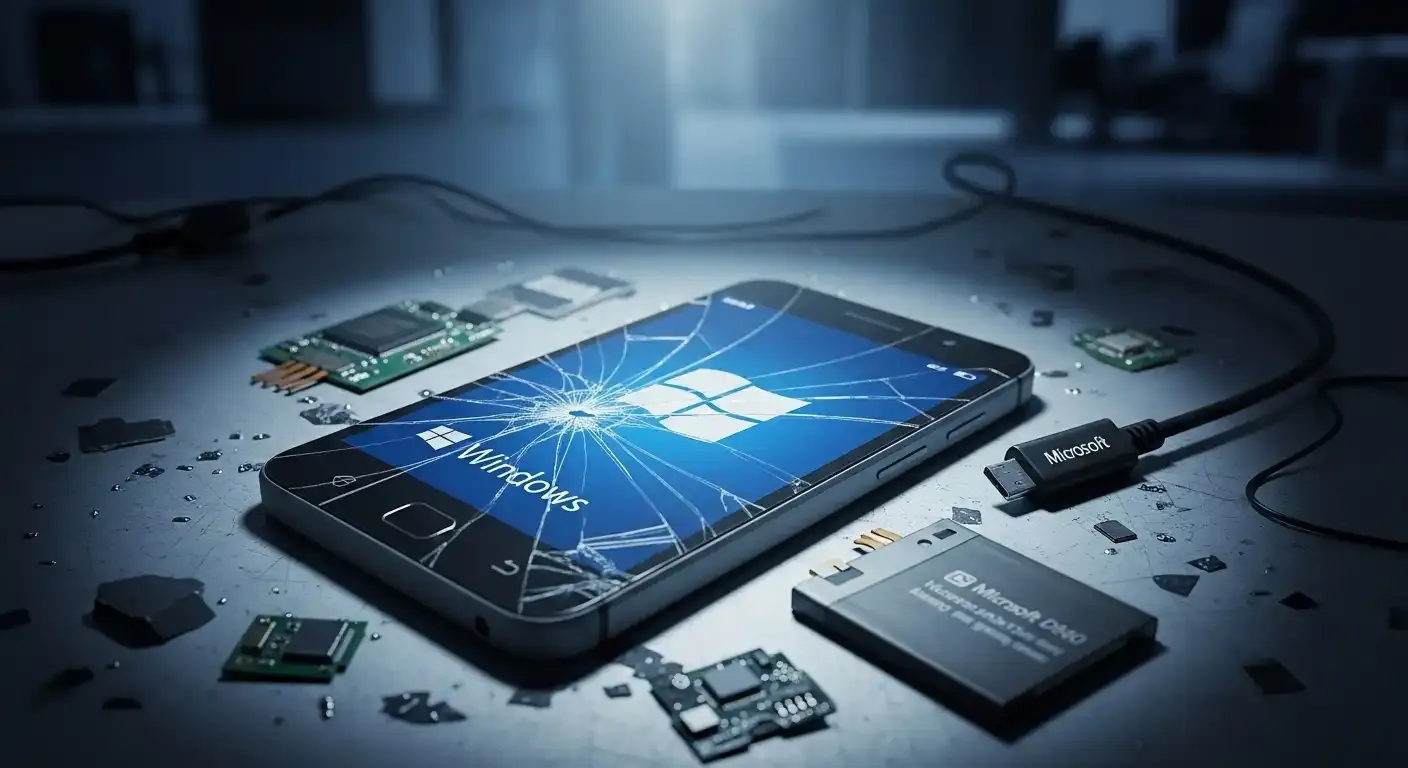
At Sprite Genix, we constantly analyze tech industry trends to understand what makes digital products thrive or perish. Few corporate case studies are as staggering as the rise and fall of Microsoft’s bold mobile experiment. Imagine reaching for a smartphone where a dazzling dance of "Live Tiles" connects you instantly to everything that matters, seamlessly linking to your PC.
That was the ambitious vision Microsoft dreamed up over a decade ago. Yet, despite a beautifully fluid interface and a passionate fanbase, the platform was ultimately scrubbed from the market and abandoned by its maker.
Why Windows Phone failed remains a masterclass in how market timing and digital ecosystems dictate survival. Today, Microsoft's fumbling of the smartphone revolution is widely considered the greatest strategic error in its history, lamented by CEOs Bill Gates, Steve Ballmer, and Satya Nadella alike. This article dives deep into the Windows Phone failure, exploring the crucial strategic mistakes, the notorious app gap, and the data-driven lessons today’s tech brands must learn.
A Vision Ahead of Its Time: The Metro UI Era
Before analyzing why Windows Phone failed, we must acknowledge its initial brilliance. Microsoft unveiled Windows Phone 7 in 2010 as a clean break from the aging Windows Mobile 6.5. The software utilized the "Metro" design language, heavily inspired by clean, classic Swiss graphic design principles and public transit signage.
Microsoft disrupted the traditional grid of static icons by introducing Live Tiles. These functioned as a hybrid of an icon and a widget, displaying real-time data without forcing users to open the application.
Furthermore, early OS versions delivered phenomenal performance. While early 2010s Android devices were notorious for stuttering and lag, the Windows Phone interface was incredibly smooth, sometimes outpacing the iPhone in visual fluidity.
3 Core Reasons Behind the Windows Phone Failure
Despite a visually stunning UI and pioneering hardware from its partnership with Nokia, Microsoft's mobile strategy unraveled. The Windows Phone failure can be attributed to three critical flaws.
1. Entering the Market Too Late
One of the primary reasons why Windows Phone failed was a catastrophic misjudgment of market timing. When the iPhone launched in 2007, then-CEO Steve Ballmer famously dismissed it, laughing off its high price and lack of a physical keyboard.
By the time Microsoft realized touchscreen-first phones were the inevitable future, Apple and Google had already cornered the market. Because Windows Phone 7 was a complete reset from older operating systems, Microsoft effectively started from scratch. This meant entering the race two to three years behind the iOS and Android duopoly, entirely missing the vital early-adopter phase.
2. The Devastating "App Gap"
No digital platform can survive without robust developer support. Microsoft was caught in a brutal chicken-and-egg scenario: consumers wouldn't adopt the platform without apps, and developers refused to build apps for a negligible user base.
This phenomenon, known as the "app gap," crippled the ecosystem. Essential applications were missing or shipped as barebones web wrappers. Google actively refused to build official apps for Windows Phone, while popular platforms like Instagram and Snapchat were absent for years. Without the applications users relied on daily, hardware superiority didn't matter.
3. Hardware Missteps and Broken Promises
In a desperate bid to save the platform, Microsoft purchased Nokia’s phone business in 2013 for a massive $7.2 billion. The objective was to emulate Apple’s vertical integration by controlling both hardware and software. However, this acquisition alienated other manufacturing partners like HTC and Samsung, who quickly retreated from the Windows ecosystem.
Moreover, Microsoft repeatedly alienated its own user base through broken backwards compatibility. Devices running Windows Phone 7 could not be upgraded to Windows Phone 8 due to kernel changes. Later, many users were denied promised updates to Windows 10 Mobile. By 2015, Microsoft essentially admitted defeat, writing down $7.6 billion from the Nokia acquisition and laying off thousands of employees.
Photographic Pioneering: The Lumia Legacy
It is important to note that the hardware wasn't the sole cause of the Windows Phone failure. In fact, Nokia and Microsoft led the tech industry in mobile photography.
The golden age of the ecosystem gifted the market the Lumia 1020. Featuring a colossal 41-megapixel sensor and a massive camera crater, it possessed a 1/1.5-inch sensor—technically larger than primary sensors found in many flagship phones over a decade later. Reviewers unanimously praised it as the best camera phone on the market, offering highly detailed imaging that still holds up today. Devices like the Lumia 930 continued this tradition with fantastic optics and early optical image stabilization.
The Final Gasp: Windows 10 Mobile and UWP
Microsoft’s final attempt to salvage its mobile relevance came with Windows 10 Mobile in 2015. The vision was highly ambitious: a Universal Windows Platform (UWP) where developers could write a single app that worked seamlessly across PCs, tablets, Xbox, and phones. The OS even included "Continuum," a feature allowing phones to act as a desktop PC when connected to an external monitor.
Unfortunately, this brilliant concept met harsh technical and business realities. The launch devices, such as the Lumia 950, were plagued by generic plastic hardware, severely overheating Snapdragon 810 processors, and buggy, half-baked software.
With market share sinking below 1% in 2016, the platform faded to black. Under CEO Satya Nadella’s leadership, development halted, and Microsoft officially pivoted to integrating its software into Android and iOS devices.
Lessons for Tech Leaders: The Sprite Genix Perspective
The Windows Phone failure proves that having a superior, innovative product is rarely enough if your timing is poor and your digital ecosystem is fractured. At Sprite Genix, we emphasize that digital success requires data-driven ecosystem building. Brands must prioritize early market adoption, continuous support, and frictionless user experiences to avoid the massive pitfalls that doomed Microsoft's smartphone ambitions.
FAQs
1. Why did Windows Phone fail despite having a great design?
Windows Phone failed primarily due to a massive "app gap." Developers refused to build apps for a platform with low market share, creating a cycle that discouraged users from adopting the devices.
2. Did Microsoft buy Nokia to save Windows Phone?
Yes, Microsoft acquired Nokia’s mobile division for $7.2 billion in 2013 to control hardware manufacturing. However, this alienated other partners, and Microsoft ultimately wrote down the acquisition as a $7.6 billion loss.
3. What was the "app gap" in Microsoft's mobile strategy?
The app gap refers to the lack of popular third-party applications on the platform. Major apps like Instagram, Snapchat, and official Google services were either severely delayed or never released.
4. Were Lumia smartphones considered good devices?
Absolutely. Devices like the Lumia 920 and Lumia 1020 were heavily praised for their vibrant designs, smooth performance, and revolutionary camera hardware, despite the limitations of the underlying operating system.
5. Is Microsoft still making mobile phones today?
Microsoft officially ended support for Windows Phone in 2017. While they briefly returned with the Android-powered Surface Duo in 2020, their core focus is now on integrating software services into existing iOS and Android ecosystems.
Ready to Scale Your Digital Presence?
At Sprite Genix, we understand that launching a product requires more than just innovation—it demands a flawless digital ecosystem. Avoid the costly missteps of tech giants and let our experts guide your growth. Contact Sprite Genix today for data-driven SEO, cutting-edge content strategies, and expert digital marketing services tailored to dominate your industry!
Category: Tech Industry Trends