

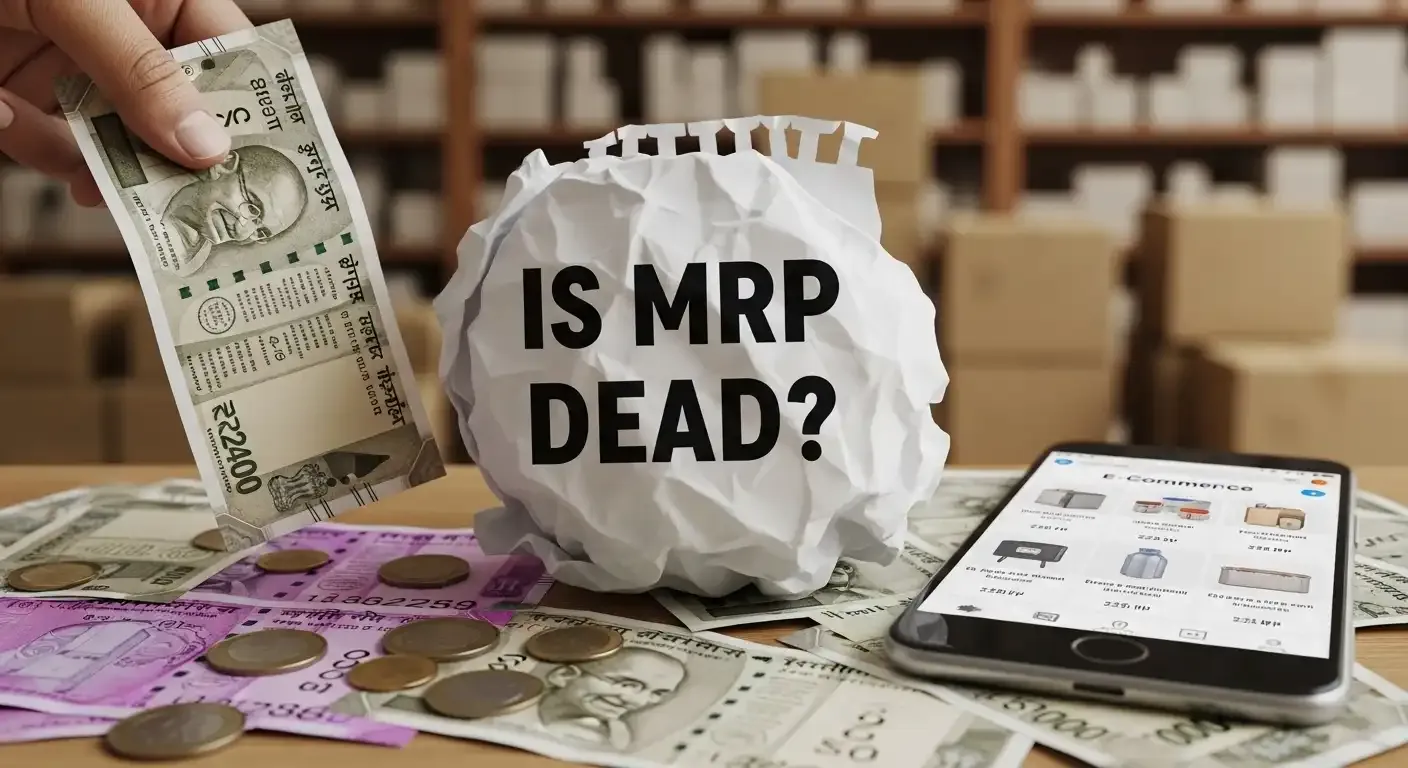
If you have ever shopped in the United States or Europe, you’ve likely noticed a distinct difference in how products are priced compared to India. In developed markets, retailers set their own prices based on costs and demand. However, India remains one of the few countries to mandate a Maximum Retail Price (MRP) printed on every packaged good.
At Sprite Genix, we constantly analyze market trends to understand the digital commerce landscape. Recently, the conversation around MRP has shifted from consumer protection to consumer manipulation. For e-commerce businesses and digital marketers, understanding the mechanics of MRP is no longer just about compliance—it is about understanding the psychology of the modern Indian shopper.
At Sprite Genix, we constantly analyze market trends to understand the digital commerce landscape. Recently, the conversation around MRP has shifted from consumer protection to consumer manipulation. For e-commerce businesses and digital marketers, understanding the mechanics of MRP is no longer just about compliance—it is about understanding the psychology of the modern Indian shopper.
In this deep dive, we explore why the MRP system is broken, how it fuels the e-commerce discount wars, and what this means for the future of retail in India.
The Origins: From Protection to Obsolescence
To understand why MRP is currently controversial, we must look at why it was created. In the 1980s, pricing was opaque. A manufacturer might list a base price, but shopkeepers would arbitrarily add "local taxes," leading to price disparities where the same packet of biscuits could cost 7 rupees in one shop and 9 in another.
Consumers in the pre-internet era had no way to verify these costs. To curb this rampant overcharging, the government introduced the MRP rule in 1990, mandating a final, all-inclusive price printed on the package. For decades, this system worked as intended, protecting the information-poor consumer. However, the rise of the internet and e-commerce has fundamentally changed the game. Today’s urban consumer can compare prices across three different apps in seconds. Yet, the MRP system remains, having morphed into a tool that often serves brands more than buyers.
Consumers in the pre-internet era had no way to verify these costs. To curb this rampant overcharging, the government introduced the MRP rule in 1990, mandating a final, all-inclusive price printed on the package. For decades, this system worked as intended, protecting the information-poor consumer. However, the rise of the internet and e-commerce has fundamentally changed the game. Today’s urban consumer can compare prices across three different apps in seconds. Yet, the MRP system remains, having morphed into a tool that often serves brands more than buyers.
The Psychology of the "Fake Discount"
The most visible sign that MRP is broken is the gap between the printed price and the selling price. Browse any e-commerce platform—Amazon, Blinkit, or Flipkart—and you will rarely see a product sold at its full MRP.
If a product has an MRP of ₹2,000 but sells for ₹900, was the product ever truly worth ₹2,000? Brands are now deliberately inflating MRPs to create a psychological anchor. When a consumer sees ₹800 crossed out next to a bold ₹430 price tag, the brain perceives a massive value add. This "fake discount" psychology is particularly potent in India because the discount appears to be on a government-mandated price cap, lending it a sense of legitimacy that "suggested retail prices" in the West lack.
For e-commerce growth strategies, this suggests that the "percent off" metric is currently a more powerful driver of conversion than the absolute price itself.
The Online vs. Offline Price War
Why do brands print such high MRPs if they intend to sell the product for much less? The answer lies in the complex ecosystem of channel conflict. Brands today must cater to two distinct masters: the low-overhead online giants (like Amazon) and the high-overhead physical retailers (shops in malls or high streets).
A physical store pays for rent, air conditioning, and staff, meaning they cannot afford to sell a vacuum cleaner at the same low margin as an online aggregator. If a brand sets a realistic, low MRP, the physical retailer would have zero margin to compete and would stop stocking the product.
To solve this, brands inflate the MRP significantly (e.g., to ₹10,000 for a ₹5,000 cost product). This allows online players to offer a 40% discount (selling at ₹6,000) while offline stores offer a 20% discount (selling at ₹8,000). Both channels survive, and the high MRP acts as a buffer that keeps the physical retail infrastructure from collapsing under the weight of e-commerce efficiency.
The SKU Loophole: How "Same" Products Have Different Prices
A common grievance among consumers is seeing the same soft drink priced at ₹20 in a grocery store but ₹50 at an airport or cinema. Legally, the MRP should be uniform. However, brands utilize a "packaging loophole."
By making minor cosmetic changes—such as altering a label color, adding a "Special Edition" badge, or tweaking the container shape—manufacturers create a new SKU (Stock Keeping Unit). Legally, this is a different product, allowing them to print a completely different MRP.
This strategy has permeated the digital space as well. You might find a shampoo bottle on Amazon with an MRP of ₹375, while the seemingly identical bottle on a quick-commerce app like Blinkit has an MRP of ₹435. Brands generate different product codes for different retailers to maximize margins based on the specific channel's logistics and commission structures. For digital marketers, this highlights the importance of SKU management in pricing strategies across different marketplaces.
The Logistics of a Vast Nation
The rigidity of MRP also ignores the geographical reality of India. A single price cap assumes that the cost of doing business is identical in a metro city like Bangalore and a remote village in the Himalayas.
In reality, logistics costs for remote areas are significantly higher. When a manufacturer caps the MRP, they effectively cap the retailer's margin. If the transport cost eats into that margin, remote retailers may simply refuse to stock the product or be forced to sell it illegally above MRP. Consequently, the uniform MRP system, designed to ensure access, often results in remote markets being underserved or subsidized indirectly by urban markets.
The Path Forward: A Hybrid Model?
Given these discrepancies, is it time to abolish MRP? Not entirely. India is not a uniform market. While urban professionals with access to price-comparison tools don't need MRP, rural consumers or those buying essential goods still rely on it for protection.
A proposed solution for the future of Indian commerce is a tiered approach. Essential goods (milk, flour, medicine) should retain a strict MRP to protect vulnerable populations. However, for non-essential categories like electronics, fashion, and home decor, moving to a "Suggested Retail Price" (SRP) system—similar to developed economies—could allow market forces to dictate fairer pricing based on actual costs and location.
Conclusion
For e-commerce entrepreneurs and consumers alike, "Maximum Retail Price" has lost its literal meaning. It has evolved into a mechanism for channel management and psychological marketing. As the Indian retail sector matures, we may see policy shifts that reflect this new reality. Until then, the smartest strategy for consumers is to ignore the strikethrough price and focus on the selling price, while businesses must navigate the delicate balance of pricing buffers to keep both their digital and physical supply chains happy.
Frequently Asked Questions (FAQ)
1. Why is the selling price often much lower than the MRP on online apps?
Brands intentionally inflate the MRP to create a "fake discount" psychology. It also creates a pricing buffer that allows high-cost physical stores to offer smaller discounts and survive, while online stores with lower overheads offer massive discounts.
2. Is it legal for the same product to have different MRPs?
Technically, no. However, brands use loopholes by creating slightly different packaging or generating new SKU codes for different channels (e.g., airports vs. shops). This legally classifies them as "different products," allowing for different printed prices.
Technically, no. However, brands use loopholes by creating slightly different packaging or generating new SKU codes for different channels (e.g., airports vs. shops). This legally classifies them as "different products," allowing for different printed prices.
3. Why was MRP introduced in India in the first place?
It was introduced in 1990 to protect consumers. Before the internet, buyers couldn't verify tax rates or base prices, and shopkeepers would arbitrarily add costs. MRP provided a ceiling price to prevent cheating.
4. Does MRP hurt rural shopkeepers?
Yes. MRP assumes a uniform cost across India. However, transporting goods to remote areas costs more. Since the price is capped, rural shopkeepers often have shrinking margins, leading them to either stop stocking products or illegally charge above MRP.
5. Will India ever get rid of the MRP system?
There is no immediate plan to abolish it, but experts suggest a hybrid model. This would keep MRP for essential goods (like food and medicine) to protect the poor, while moving to a "Suggested Retail Price" for non-essentials like electronics.
Category: E-commerce Growth