

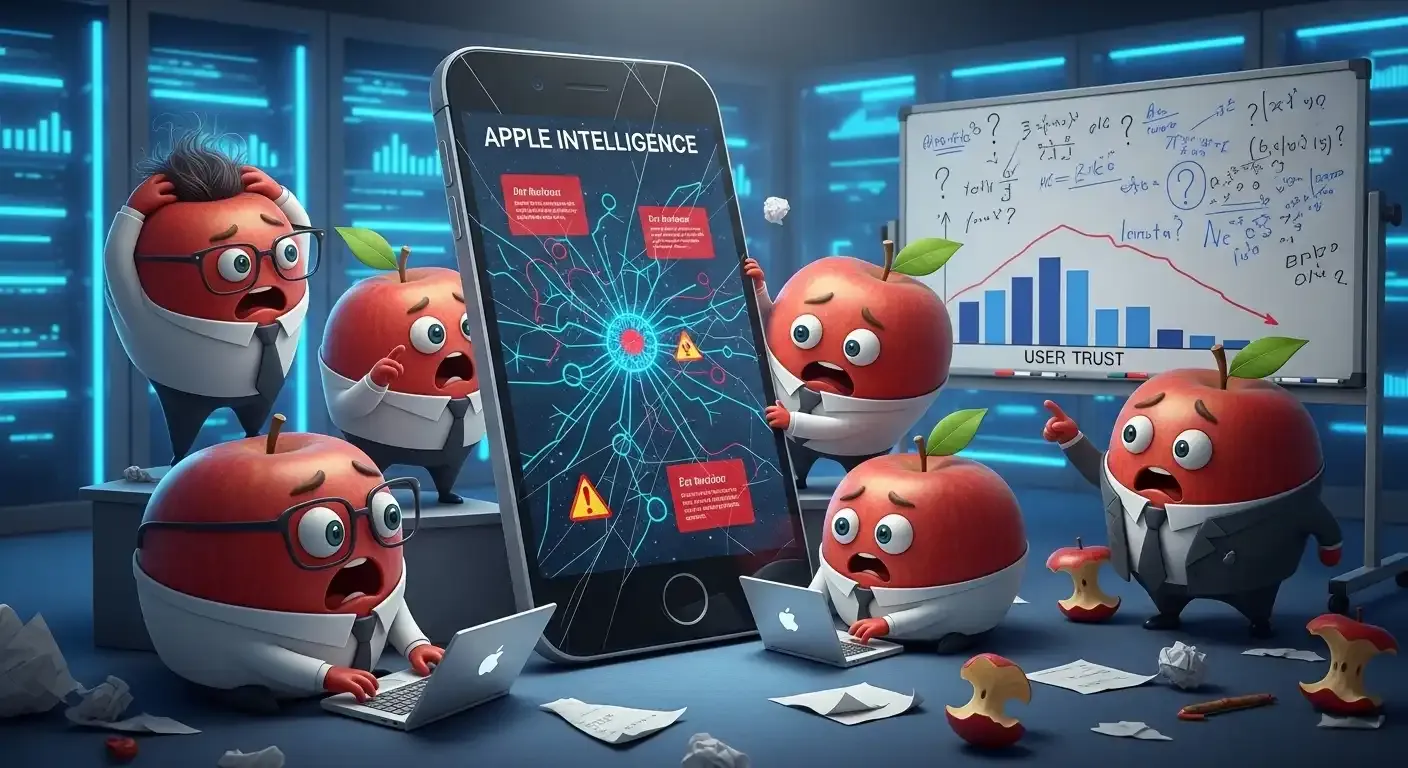
Is the Tech Giant Losing Its Edge?
For decades, Apple has been synonymous with inventing the future. Under Steve Jobs, every keynote felt like a revolution waiting to happen. It was a concept-oriented company that didn’t just make products; it defined lifestyles. However, a shifting narrative suggests that under Tim Cook, Apple has transformed into a "mechanic giant"—a product-oriented company that refines rather than revolutionizes.
Today, Apple faces a massive technological shift that threatens its trillion-dollar empire: Artificial Intelligence. While competitors like Google and OpenAI are sprinting ahead, industry analysts suggest that Apple’s AI is floundering. At Sprite Genix, we believe it is crucial to look beyond the shiny surface of the iPhone 16 and understand the structural and financial crises brewing in Cupertino.
The Fall of Siri and the Rise of "Real" AI
When Siri launched, it was four years ahead of the competition, promising a future where we could talk to technology. It was touted as being as revolutionary as the computer mouse. Fast forward to today, and the landscape has changed drastically. While Alexa runs homes and Google predicts needs before they arise, Siri often feels like a "dumb assistant" in the age of generative AI.
The contrast is stark. OpenAI is releasing agentic features and Google is flexing its Gemini models, yet Apple’s biggest recent updates remain focused on camera improvements and battery life. Even the much-hyped "Apple Intelligence" is still in beta, a year late to the party. This lag raises a terrifying question: Is Apple clinging to privacy and polish because it has lost the ability to innovate?
The Economics of Intelligence: The Token Trap
To understand why Apple is in trouble, we must look at the economics of AI, specifically Application Programming Interfaces (APIs) and Tokens.
An API acts as a digital bridge. When you ask a question, your voice is converted to text and sent as a request to a server (like OpenAI’s), which processes the query and sends an answer back. This exchange runs on "tokens," the digital currency of AI.
Here lies the problem. In traditional SaaS (Software as a Service) models, like Canva, profit margins increase as you scale. Fixed costs remain steady while the cost of serving each new user drops due to bulk discounts on storage and servers.
AI SaaS operates differently:
• Compounding Costs: Every interaction burns compute power.
• Diminishing Margins: The more users you have asking questions, the higher your costs climb.
If Apple relies on OpenAI to power its intelligence, the math is brutal. If 1 billion Apple devices make just 12 requests per day, and each request costs a fraction of a cent in tokens, the daily cost could hit 180million.Overayear,thatisroughly∗∗65 billion**.
Considering Apple’s net profits in 2024 were around $93 billion, outsourcing AI could wipe out nearly 70% of their annual profit. Unlike traditional software where scale is a blessing, in the AI world, scale without owning the infrastructure is a financial disaster.
The "Stack" War: Why Google Has the Advantage
The reason this is a crisis for Apple—and not necessarily for Microsoft or Google—comes down to the "AI Stack."
A complete AI stack consists of the Model, Compute, Data, and Platform.
• Microsoft: Has a significant stake in OpenAI and hosts it on Azure. If OpenAI burns money on compute, Microsoft (the landlord) still gets paid.
• Google: Google owns the entire vertical. They have the models (Gemini), the proprietary chips (TPUs), the data centers, and the distribution (Android, Chrome, YouTube).
Google’s Tensor Processing Units (TPUs) allow them to operate at approximately 20% lower costs than entities relying on Nvidia GPUs, with processing speeds 15 to 30 times faster. Because Google owns the "factory," they can scale AI to billions of users without bleeding cash. Apple, by contrast, is currently just the "dumb glass" displaying AI built by others.
The BlackBerry Parallel
The most haunting comparison for Apple investors is BlackBerry. In 2007, when touchscreens emerged, BlackBerry doubled down on what it knew best: security, privacy, and keyboards. By 2013, the company that once owned half the market was a case study in failure.
Today, Apple is doubling down on "privacy, polish, and perfection" while the AI revolution rewrites the rules of the industry. BlackBerry failed because they believed their "moat" (security) would save them from a platform shift. Apple risks making the same mistake. If users eventually value intelligence over interface, brand loyalty will evaporate. If an AI agent on a Pixel phone knows you better than your iPhone does, the hardware becomes irrelevant.
Apple’s Defense Strategy
Apple is not oblivious to these threats. They appear to be building a two-layer defense to mitigate reliance on external providers:
1. On-Device Processing: Apple Intelligence aims to handle simple, private tasks (like summarizing notifications or rewriting text) directly on the iPhone or Mac. This requires no external API calls, saving money and preserving privacy.
2. Private Cloud Compute: For heavier tasks, Apple is building its own server infrastructure to handle generative tasks without relying entirely on third parties.
The strategy is to only send the most complex queries (like "Ask ChatGPT") to OpenAI, perhaps reducing the paid queries to one in twenty. However, as AI becomes more agentic and integral to daily life, the number of complex queries will inevitably rise, straining this defense.
Conclusion
Apple is currently at a crossroads. They have the cash, the talent, and the user base to pivot, but the structural economics of AI are working against them. They are attempting to transition from a hardware hegemon to an AI contender without destroying their profit margins.
The hope is that Apple has a "Next Big Thing" hidden in the labs—perhaps a revolutionary version of Siri or Apple Glass in 2026. But for now, the reality is stark: Apple is playing catch-up in a race where the cost of participation is compounding daily. As we watch the tech industry trends shift, the question isn't just whether Apple can build AI, but whether they can afford the price of admission.
Frequently Asked Questions (FAQ)
1. Why is Apple considered to be "failing" in AI compared to Google?
Apple is considered to be lagging because while companies like Google and OpenAI are releasing advanced "agentic" features, Apple's updates have focused on hardware. Furthermore, Google owns the entire "AI Stack" (data, chips, and models), whereas Apple relies on external partners, making them slower and more vulnerable to costs.
2. What is the "Token Problem" mentioned in the article?
Tokens are the currency of AI processing. Unlike traditional software where costs decrease as you scale, AI costs increase with every user interaction. If Apple pays for every Siri request sent to OpenAI, the costs could reach upwards of $65 billion annually, severely impacting their profits.
3. Is Apple the new BlackBerry?
There are fears of a parallel. Just as BlackBerry focused on security and keyboards while ignoring the touchscreen revolution, critics worry Apple is focusing on privacy and polish while missing the AI revolution. If they don't adapt, they risk losing market relevance.
4. How is Apple trying to solve the high cost of AI?
Apple is using a two-layer defense. They are processing simple tasks "on-device" (on the iPhone itself) and using their own "Private Cloud Compute" for medium tasks. They only outsource the most complex queries to OpenAI to keep costs down.
5. Does Google have a financial advantage in AI?
Yes. Google uses its own custom chips called TPUs (Tensor Processing Units), which are cheaper and faster than the Nvidia GPUs used by OpenAI. Because Google owns the chips, the data centers, and the models, their cost per token is significantly lower than Apple's potential costs.
Category: Tech Industry Trends