

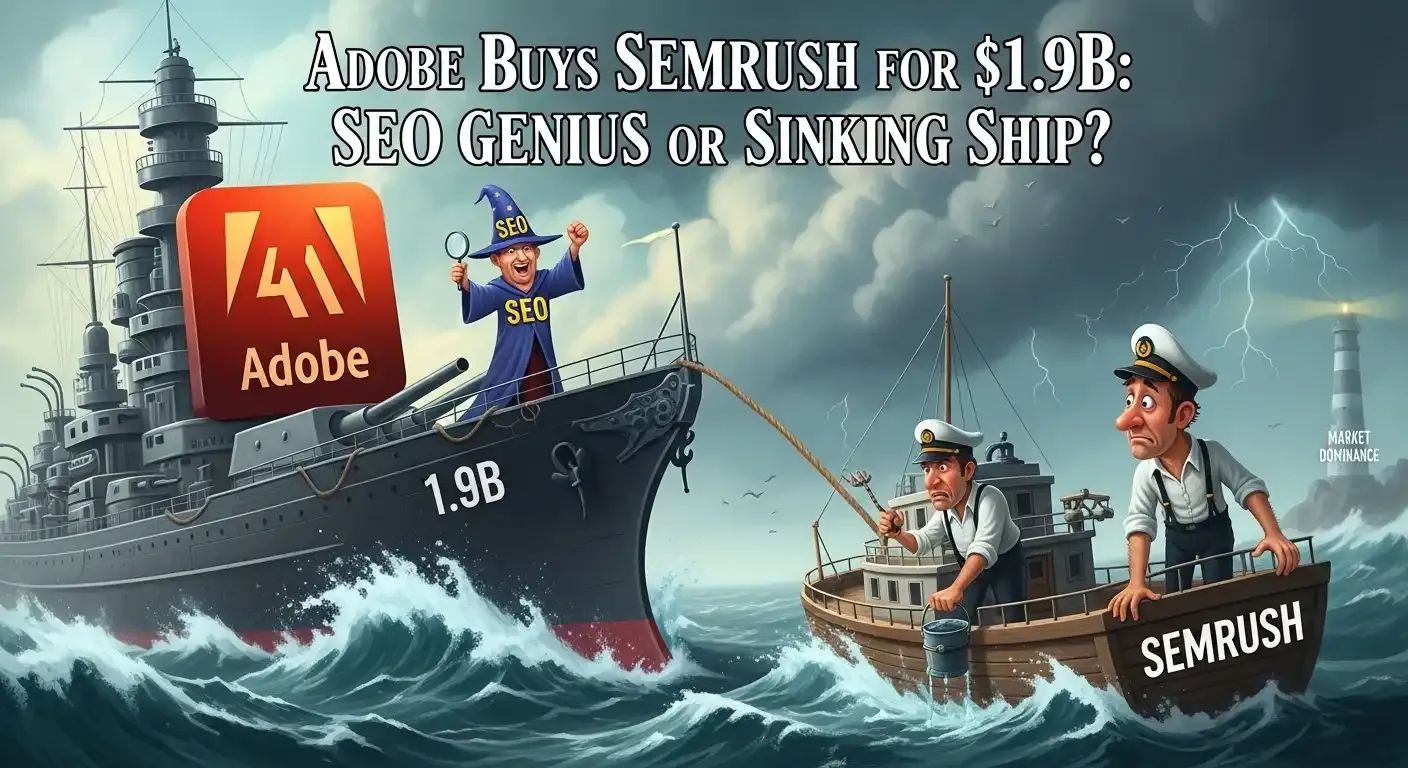
A massive development has shaken the marketing and creative-tech ecosystem: Adobe has officially acquired SEMrush for a staggering $1.9 billion USD.
On the surface, this appears to be a bullish signal for the SEO industry. A global enterprise software giant committing nearly $2 billion into search intelligence suggests long-term confidence in organic marketing.
But at Sprite Genix, we analyze beyond headlines.
This acquisition is not just about SEO expansion. It may be a strategic survival move in response to the accelerating dominance of Generative AI.
Let’s break it down with precision..
The Legacy of Adobe: An Unbeatable Monopoly
To truly understand this acquisition, we must first look at Adobe's historical dominance. Many marketers may only know Adobe superficially, but long-time users understand the sheer magnitude of the company's influence. Adobe's products have been an industry standard for decades. Since 2002, when Photoshop was just finding its footing, Adobe has cultivated a fiercely loyal customer base.
People commonly associate Adobe solely with Photoshop, the world's most popular image editing program, but that is merely the tip of the iceberg. For a dedicated Adobe user, the ecosystem is incredibly vast and essential for professional workflows. The suite includes:
• Illustrator for illustrations
• Acrobat for PDFs
• Premiere Pro for video editing
• After Effects for motion graphic designing
• InDesign for print work
• Audition for audio editing
• Lightroom for professional photographers
Adobe is not your average tech company offering a free tier to casual users; their customer base consists of paying professionals and massive movie studios. The very tools that make your favorite movies and television shows watchable are powered by Photoshop, After Effects, and Premiere Pro. For years, countless companies tried to beat Adobe, but none could even come close. Until 2023, Adobe held a larger monopoly in the creative industry than Google holds in search.
The Generative AI Disruption: A Sinking Ship?
The turning point for Adobe's unassailable empire was the year 2023, which saw the explosive emergence of Generative AI and Large Language Models (LLMs). Generative AI did not just send ripples through the search engine industry; it completely disrupted the creative field.
Historically, image and video editing was an incredibly manual process. All designing and editing tools relied on the manual manipulation of pixels. To succeed, a user needed to possess deep creativity to imagine an outcome, combined with years of grueling practice to master the complex tools required to make that imagination a believable reality. Generative AI changed everything by creating pixels out of thin air. Today, you only need the creative vision; the AI and LLMs take care of the heavy lifting, the tools, and the practice.
Despite having immense financial resources and vast amounts of user data, Adobe's initial reaction to the Gen AI boom was slow and lazy. They did introduce some AI upgrades that made tedious tasks—like selecting objects and colors in Photoshop—much faster and easier. However, Adobe mistakenly believed these minor, incremental updates would be enough to maintain their dominance.
The Rise of the "Adobe Killers"
While Adobe was slowly updating its legacy software, highly aggressive and specialized Generative AI companies entered the market. Suddenly, in every single direction where Adobe used to have zero competition, new AI companies began offering better, faster, and easier products at a fraction of the cost—sometimes even for free.
These powerful new competitors include:
• Google’s Nano Banana for highly advanced image manipulation
• OpenAI’s Sora and Google’s Veo, which are producing incredible results in video generation
• ElevenLabs, which dominates the audio space
• Lovable, which is streamlining web development
In response, Adobe launched its own generative AI tool called Firefly. In principle, because Adobe has been the king of image editing forever and caters to top-tier professionals, Firefly should have been ten times better than tools like Google's Nano Banana. Unfortunately, it is not. In fact, Adobe's internal frustration with Firefly reached such heights that they actively started testing Google's Nano Banana inside of Photoshop.
For marketers, testing different options with varying accuracy might seem acceptable, but for Adobe's core users, it is a disaster. Adobe makes its money from elite professionals who must deliver a flawless, ready-to-consume finished product. If Adobe cannot provide the best tools, and a competitor can do it in less time, with fewer steps, and at half the price, these paying professionals will inevitably jump ship. Adobe is failing to crack the Generative AI code, and the structural cracks in their monopoly are becoming highly visible.
The Real Reason Adobe Bought SEMrush
So, why did Adobe just spend $1.9 billion on an SEO platform? Is Adobe stepping in to save SEMrush? The short answer is no.
The reality is that Adobe just bought a boat with a giant hole in it while standing on a sinking ship of its own. While this is a fantastic deal for SEMrush and its investors—especially since many in the industry feel SEMrush is past its prime time—it is a desperate move by Adobe.
Adobe already owns Adobe Analytics, which successfully caters to the high-end, enterprise market. SEMrush, on the other hand, dominates the small-to-medium-sized market. By acquiring SEMrush, Adobe is essentially buying access to a brand new demographic to generate immediate revenue. Adobe is not looking to be the savior of SEMrush or the SEO industry; they are simply hoping to turn SEMrush into a much-needed "cash cow" to offset their struggles in the creative AI space.
What This Means for the SEO Industry
For those of us in the SEO community, this acquisition brings significant risks. Adobe's primary goal is to extract profit, which means they might drastically cut off parts of SEMrush that they view as non-money-making entities. A major concern is the fate of Search Engine Land. Regardless of personal opinions on the publication, Search Engine Land is a highly useful and vital resource for the SEO industry, and we simply do not have many platforms like it left.
Furthermore, if the current board of SEMrush truly cared for the long-term scaling of their company, they should have explored other options. Adobe is currently an enterprise in trouble, lacking the strong Generative AI team it desperately needs. Things in the SEO landscape might look okay for the next year or two, but if Adobe fails to innovate dramatically, we might eventually see Adobe itself being taken over by giants like Google or Apple.
As digital marketers, we must stay vigilant. The tools we rely on are changing hands, and the integration of AI is dictating the survival of the biggest tech monopolies in the world.
5 Frequently Asked Questions (FAQs)
1. How much did Adobe pay to acquire SEMrush?
Adobe acquired the SEO tool SEMrush for 1.9 billion American dollars (USD).
2. Why do many SEO professionals view this acquisition as a positive sign?
Many people in the SEO industry believe that a massive tech giant like Adobe investing $1.9 billion into an SEO tool indicates strong confidence and positive momentum for the future of the search marketing industry.
3. What generative AI tools are currently threatening Adobe's monopoly?
Adobe is facing severe competition from AI companies that do the job faster, easier, and cheaper. Competitors include Google's Nano Banana (image manipulation), OpenAI's Sora and Google's Veo (video generation), ElevenLabs (audio), and Lovable (web development).
4. Why is Adobe struggling with its own generative AI tool, Firefly?
Despite Adobe's long history in professional image editing, their generative AI tool, Firefly, is underperforming compared to competitors. The results have been so frustrating that Adobe even began testing Google's Nano Banana directly inside Photoshop instead of relying solely on Firefly.
5. How might this acquisition negatively impact the SEO community?
Because Adobe views SEMrush primarily as a "cash cow" to make money from the small-to-medium market, there are fears that Adobe will cut off non-profitable parts of the company. This puts vital industry resources, such as the publication Search Engine Land, at severe risk of being shut down or sold off.
Category: Industry News and Updates